









Roohy for kids
Brain activation exercises for kids that feel like play
- For ages 3–9+, adapted to your child’s age
- Up to 15 minutes a game
- No special equipment: just things you have at home
What are brain activation exercises for kids?
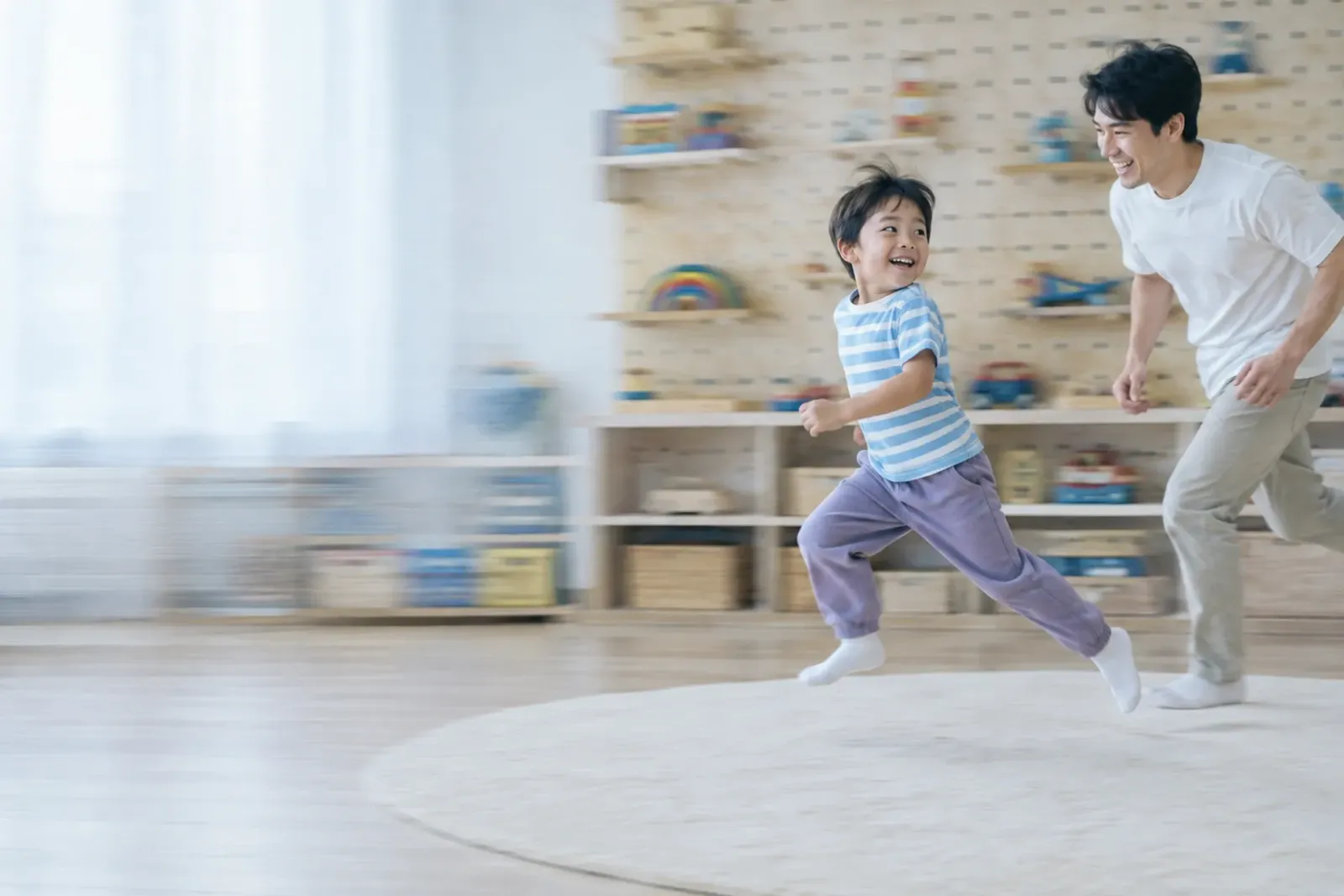
Brain activation exercises for kids are short games and activities that ask a child to actively use thinking skills: keep a rule in mind, wait for a signal, remember a sequence, or switch to a new rule mid-game.
They aren’t worksheets, flashcards, or tablet puzzles. Most of the play happens off-screen, between you and your child.
Every day, a new game is ready on your phone, with the rules explained step by step.
Made for every age
Roohy adapts every game to your child’s age, so the rules, pace, and challenge feel just right. A game that starts as a simple stop-and-go at 4 can become a three-rule challenge at 9.
- 3–4
- 5–6
- 7–9
- 9+
What changes with Roohy?
Before Roohy
Play is fun, but it’s hard to know which skills it’s actually building.
- You scroll for ideas and guess what fits their age
- Explaining the rules takes longer than the game
- The same game gets old by day three
With Roohy
Every game helps your child practice a real skill: focus, self-control, or flexible thinking.
- A game picked for your child’s age is ready tonight
- One step at a time on screen, so you just play along
- New games and harder levels keep it fresh
What your child practices in every game
Each Roohy game is built around a clear skill, so the fun always has a purpose.
Focus and memory
Copying a growing chain of moves (nose, jump, spin… what came next?) asks your child to pay attention and keep the whole sequence in mind.
Self-control
Stop-and-go games like Freeze Dance give kids a fun reason to pause, wait for the signal, and choose their next move.
Flexible thinking
Rule-switching games, like jumping to blue when you call red, let kids practice letting go of one rule and trying another way.
Emotional regulation
When a tower wobbles or a drawing doesn’t come out right, your child gets a low-stakes chance to take a breath and give it another go.
Bilateral coordination
Cross-crawls, where a hand touches the opposite knee, and balance games get both sides of the body working together. Expect some wobbling and plenty of giggles.
Roohy vs. screen-based brain games
These brain development games for kids are made for two players: your child and you. You move, wait, remember, and laugh together, while the app quietly keeps track of the rules.
How Roohy for kids works
You tell us your child’s age and what you’d like to work on. Your answers shape a step-by-step plan of games.
Each day, a new game is ready to play. Want more? Pick an extra game whenever you both feel like it.
The app shows one step at a time: what to say, what to do, and when to switch things up. You focus on playing, not on running the game.
Favorite games come back later with new rules and harder levels, so there’s always a next challenge.
Roohy games are built on play-based learning. The Harvard Center on the Developing Child describes how games with rules, movement challenges, and pretend play give children everyday practice with skills like working memory, self-control, and flexible thinking.
What feels hardest right now?
Pick one, and we’ll start your child’s plan there.
How you’ll know it’s clicking
Skills like focus and self-control grow gradually, with lots of practice. Here’s what you may notice along the way:
Your child remembers the rules from last time and asks for “the freeze game” again.
Rounds last longer, and the harder levels start to feel doable.
Waiting for the signal or switching to a new rule gets a little easier in the games.
Your child starts to lead: calling the rules, inventing twists, and teaching you.
Some days will go better than others, and that’s part of it. Short, regular games tend to fit family life better than one long session once in a while.
Start playing tonight
Take the quiz
Tell us your child’s age and what you’d like to work on together.
Open your plan
Create your account and open your plan on the web or in the Roohy app for iOS and Android.
Play the first game
Follow the steps on screen and have fun. Enjoyed it? Tomorrow’s game will be ready.
FAQ about brain activation exercises for kids
They’re short, playful games that ask kids to use thinking skills like focus, self-control, memory, and flexible thinking. With Roohy, they come as a ready-made plan: one age-adapted game a day, with steps for you on screen.
Research on child development shows that kids develop skills like self-control and working memory through games with rules, movement, and pretend play. Brain activation exercises give that moment a regular spot in your day. Like any skill, it builds gradually, and every child moves at their own pace. Roohy for kids isn’t a treatment and doesn’t replace advice from a pediatrician or specialist.
Roohy for kids is a plan of short brain-building games that you play with your child. A quiz shapes the plan around your child’s age and goals, and the app guides you through each game, step by step.
It’s for kids from age 3. Every game is adapted to one of four age groups: 3–4, 5–6, 7–9, and 9+.
Each game takes up to 15 minutes. There’s one new game a day, and you can add more whenever you both want.
No. Most games use things you already have at home, like paper, cups, or music, and some need nothing at all.
No. The phone is for you: it shows the steps. Your child plays with you, off-screen and face to face.
That happens. Skip a day, replay a favorite, or let your child pick the game. Your plan always shows the next step, so you can pick up right where you left off.

Not sure Roohy fits your kid?
Tell us a little about your child, and the Roohy team will help you figure it out.
 English
 Deutsch
 Français
 Español
 Italiano
 Português
 Português (Brasil)
 Polski
 العربية
 Čeština
 日本語
 Türkçe